


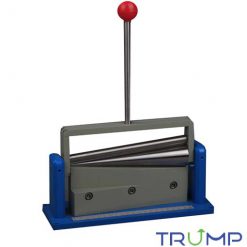
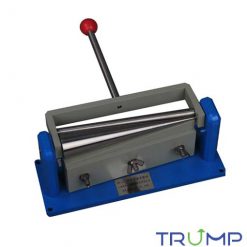
Conical Mandrel Bend Tester
ZW-Ⅰ Conical Mandrel Bend Tester is applicable to evaluate crack resistance and detachment from the metal substrate of coated surface which are clamped in position and formed round the conical mandrel by rotation of the roller frame. Complying with ASTM D522(1979), it is also applicable to evaluate resistance to cracking (flexibility) of attached coating on the substrates of sheet metal when elongated.
Main Technical Parameters:
Dimension of conical mandrel (GB11185-89): Big end: 38mm
Small end: 3.2mm
Length: 203mm
Overall dimensions ( not install handle) : 280×110×120 mm
Weight: 9kg
Operation:
1.Substrate: 100mm×180mm—complying with GB11185-89, panels of burnishing steel, burnishing tinned plate, or soft sheet aluminum up to 0.8mm thick can be tested. 114mm×177mm–complying with ASTM D522-60(1979), the substrate shall be cold-rolled steel strip 0.8mm thick. Prior to the application of the coating, round slightly the edges of metal panels to remove burrs in order to eliminate anomalous edge effects. ZW-Ⅰ Conical Mandrel Bend Tester designed in consideration of the maximum thickness of a metal plate of 0.8mm, do not use non-standard panel so as to avoid damage to instrument.
2.Condition the test specimens for at least 24h at 23℃±2℃ and 50±5% relative humidity and test at least three replicate specimens in the same environment, unless otherwise specified by the purchaser and seller.
3.Procedure: With the operating handle of the apparatus going to the front in a horizontal position (at scale); slip test specimen between the clamp and the clamp support with the finish side towards roller, rigidly clamp specimen in a vertical position adjacent to the mandrel by placing the long edge behind clamp support in such a manner that the panel is always set up to the narrow end of the mandrel. Tighten wingnut, fold the test panel around the cone by using the manually operated handle that is pivoted at the ends of the axis of the cone. For testing, uniformly bend the coated samples over the bending mandrels within 2-3 seconds at 180 degrees. Loosen wingnut & remove the panel.
Examine the bent surface of the specimen immediately with the unaided eye for cracking. The apparatus doesn’t arranged panel, users has to provide for themselves
Ordering Information:

มาเป็นคนแรกที่วิจารณ์ “Conical Mandrel Bend Tester”
สินค้าที่เกี่ยวข้อง


รีวิว
ยังไม่มีบทวิจารณ์